
INDIA / GENERAL / APP REVIEW
Com App Download Review: File Checks, Install and Login
Com App Download describes a file-and-reference workflow rather than a single universal app. Begin by identifying the catalogue entry, then distinguish the parent Android bundle from any file reached through it. The guide explains the download evidence, installation questions and account boundaries documented in the source.

The four task buttons jump to guide sections on this page. The source record is a documentary reference.
Our assessment
A named download is useful only when the publisher, package and release reference identify the object you intend to obtain. A matching parent bundle does not verify other files it may mention. This assessment explains the available evidence without reporting a completed in-app download or account session.
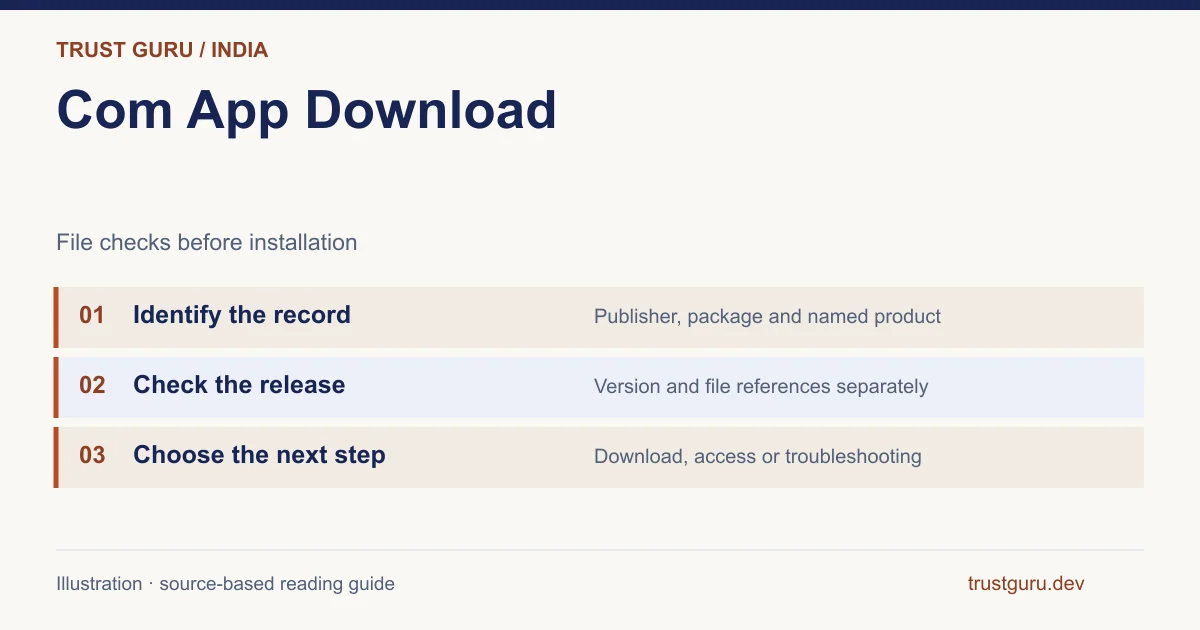
In this review
Source details and review scope
The record being reviewed
- Source label
- Com App Download App
- Listed developer
- WinSports Hub
- Listed version
- 1.0
- Listed size
- 19.74 MB
- Review scope
- Published documentation and task analysis
We compare published source records and file evidence. We have not installed the app, created an account or tested a login. Similar labels can refer to shared files or different services.
COM wording is a source label, not an established alias
The catalogue attributes Com App Download App to WinSports Hub and publishes version 1.0 at 19.74 MB. The incoming-file proposal spans browser, file-manager and sharing routes, so the selected object and its original acquisition path matter before any comparison result. The attribution remains a source statement rather than an independently authenticated company identity. The common Standard reference identifies com.come.sports version 1.0/code 1. Its contents include the website’s descriptive entries, which does not establish a separate implementation for every catalogue title. Another display name may refer to another page in that container rather than another Android application.
An install condition is more meaningful than a warning badge
This hub is described around files arriving from a browser, a file manager or a sharing action. Its distinguishing promise is refusal: a mismatch should never receive an install option. That requires evidence of what the hub actually read and why it withheld the action. A supplied reference string and Copy button do not establish that behaviour. The review did not exercise a matching file, failed comparison or Android handoff through an attributable hub implementation.
Browser, file-manager and share-target routes need separate checks
A readable filename from a share target is not necessarily a persistent local file the hub can reopen later. A catalogue should identify what an entry represents and what state it has reached. Listed, acquired, readable, compared and accepted by Android describe different events. Each child package needs its own release reference; the catalogue’s version cannot identify them all. A shared website page or hosted-shell configuration does not demonstrate a persistent local index. No moved-file handling, duplicate reconciliation or private-library restoration was observed. The source can still define an organisational idea, provided its claims remain separate from concrete file findings and the reader can see which implementation evidence is missing.
The archived page does not show which Android share actions are registered or whether the hub copies, references or streams an incoming object. We cannot confirm coverage of every browser or file manager. If one route cannot preserve a source URL, the interface should say so rather than imply provenance it did not receive. A copied reference string is not a measured result from the selected file.
Acquiring the hub: the first file requires its own provenance
The advertised hub spans browsers, file managers and share targets. To assess an incoming file, retain where it came from and which release was intended. A completed browser transfer does not demonstrate the hub reading that object or refusing a mismatch. The inspected Standard object is com.come.sports version 1.0/code 1, 20,696,772 bytes, SHA-256 6bf5b47239c4407dfb97d7c49b5639ab1f7b335fb5fff05e0360aa1f11338ccd. Current and archived filenames returned identical bytes. The separate Game object is not an older or newer release of that package. Preserve the release reference and observation date so later findings are compared with the same object and stage. Record which manifest row names that object before comparing another download.
Installation and incoming-file verification are separate milestones
There are two handoffs to establish: Android accepting the hub, and the hub passing a selected child file to Android. Neither follows from the other. The source panel’s assertion that its file cannot be installed also conflicts with the measured shared package. For the acquired Standard file, minimum SDK 24 means Android 7.0; target SDK is 36 and debuggable=true. Project-local static APK v2 signed-data and content-digest checks used its Android Debug certificate. This establishes a file-level signing result, without publisher authentication, installation, safety certification or runtime testing. Preserve the release reference and observation date so later findings are compared with the same object and stage.
Keep the hub’s file evidence distinct from generic installation advice and from any incoming child package. A guide retained for the 30 October 2026 review states Android 8.0, while the acquired Standard hub declares minSdk 24, equivalent to Android 7.0. The guide did not measure this release, so its value must not overwrite the manifest reading or disappear from the account of the evidence. Neither value guarantees handset acceptance, an update or hosted-service availability. Those outcomes were not tested, and the child installer would still require its own compatibility assessment.
Login: identify whether an incoming route needs an account
An incoming-file list is not evidence of a private user library. The saved source does not establish which functions require authentication, whether a phone number is accepted or whether preferences synchronise. No genuine login endpoint or recovery path is demonstrated. The investigation did not submit credentials, request an OTP or inspect a signed-in session. For an existing account, retain the actual provider and stage reached before changing software. A failed page load, rejected password and missing local record require different evidence. Trust Guru cannot authenticate a user or restore a provider-managed profile. Preserve the release reference and observation date so later findings are compared with the same object and stage.
Registration should have a purpose beyond the word download
A browser share action, a folder-access consent and a user-registration form request different kinds of access. Identify which action is actually being requested before treating them as one setup procedure. The source supplies no confirmed new-user fields or consent screens. The assessment performed no registration or agreement. Obtaining a file, allowing an Android permission, reading a public page and joining an external service have different consequences. Any required data and location restrictions must come from the identified provider’s current process. Neither a catalogue caption nor a checksum can establish that an account is approved. Preserve the release reference and observation date so later findings are compared with the same object and stage.
A local reference is useful only when its origin remains visible
The page argues that bundled manifest pages prevent a file from being checked against a table fetched alongside it over the same network. Keep the expected release separate from the object being checked. A local table can remain available without a connection, but its origin still depends on the bundle that delivered it and any update process. Reading a file’s own label and treating it as the expectation would be circular. The record needs an attributable reference date, complete identity and an explicit state for unknown or changed releases. No signed refresh, expiry rule or conflict-resolution behaviour was demonstrated. Preserve the earlier comparison as history if the reference later changes, rather than silently rewriting what an old result meant.
It does not make the reference independent merely because it is stored locally. Without that, a user cannot tell whether a failure means different bytes, a newly released package or an old reference. We have not tested reference updates, tamper resistance or an expired row. A result should identify the table it used and its date. Its central promise is not just calculating a digest; it is supplying an expectation the user intended and explaining the relationship between that expectation and the incoming file.
Offline comparison is not the same as offline acquisition
Even if implemented, that would not mean a new remote file can be downloaded without connectivity. Separate initial availability from later use. Content shipped inside a package, a page cached after visiting it and information retrieved afresh require different connections. Reading a saved explanation cannot establish current team news, new releases, an external account or a newly downloaded file. A useful offline record also retains when its information was obtained. Restart, eviction, reconnection and changed-file behaviour need their own observations; none follows merely from a small installer or a local-reference claim. For travel, retain the intended document and its source date independently of any untested promise about complete offline operation. Similarly, an unknown file should not become a false failure merely because the hub cannot fetch a current row.
Superseded means more than merely older
One distinctive feature line says version tracking marks a superseded build as superseded rather than simply older. Compare releases using their complete identity and chronology. A display version, wrapper version, article update and remotely supplied page can change independently. The two Standard filenames returned identical bytes, so their current/archive labels do not establish an upgrade or rollback. Game belongs to another package and signing reference. An older wrapper cannot be assumed to recover an account, restore removed host content or preserve local notes. Before a replacement decision, identify the installed package, accepted signing relationship, proposed file and any state that matters. No migration or device replacement outcome was measured here.
A useful hub should identify the evidence for that status rather than infer it solely from a larger version number. The archived page does not provide a running history or a tested example of supersession.
File history can be sensitive even without account documents
For the shared Standard package, the parsed manifest contains INTERNET and an app-specific receiver permission, without the source's four disallowed classes of SMS, contacts, accessibility or device administration. Read permissions as declarations in a particular file, then ask which task and recipient would use them. A manifest does not record a phone’s granted permissions, runtime prompts or transmitted data. Standard and Game have different declaration sets and must not inherit each other’s privacy conclusion. Local readability also cannot establish an absence of network communication. A file list, selected folders, personal analysis and an external account can expose different information. This review did not capture traffic, inspect private account data or complete a runtime privacy assessment, so it provides scoped observations rather than a safety or privacy score. The source’s local-reference claim does not answer network or analytics questions.
Resolve which stage failed before retrying
The source does not by itself establish a tested support resolution.
If the same file works through one share path but not another, that suggests an access or integration problem rather than a changed digest. If the object is unreadable, no mismatch verdict is available; if it differs, agreement cannot be created by choosing an unrelated reference with a similar name.
A hub, an archive and a sports-only downloader serve different moments
The catalogue attributes Com App Download App to WinSports Hub and publishes version 1.0 at 19.74 MB. Choose a comparison by the result needed rather than a similar name. A retained-file archive, one-time checker, website reader, planning method and hosted-service shell require different evidence. The related records make those task boundaries inspectable, but shared metadata prevents treating every directory label as a proven independent implementation. There was no installed usability comparison or measured product ranking. A narrower record can be more relevant when its documented task matches the reader’s question; a longer feature list is not evidence of a better result. Preserve the identity and limitations of each alternative when moving between them.
The same APK opens from one route but not another
Different access paths can explain different results without changing the file. In a hypothetical case, a browser saves an APK that a file manager can read, but a share action into a proposed checker produces no object. That observation points first to the handoff and read permission, not to a new checksum. A source claim about several incoming routes does not demonstrate those routes in a running interface. Keep the entry path and exact message with the intended package.
Once both paths can read the same complete object, compare measured bytes rather than filenames. If one route actually created a second copy, establish each copy’s size and digest before calling them identical. An inaccessible object has no failed-hash result; a different digest is an actual comparison outcome against a named reference. If the received item is an HTML reading page or a hosted-service shell, return to its identity rather than forcing a local-checker workflow onto it. This sequence makes the unresolved step clear while preserving private file contents and any existing installation.
- Record each path and whether it produced a readable local object.
- Measure copies separately if the handoff created another file.
- Move to installation only after identifying the intended release.
| Observation in the example | What it establishes | Next decision |
|---|---|---|
| File manager reads it; share action returns nothing | The paths have different observed access results | Keep the handoff evidence before questioning integrity |
| Two saved copies have different digests | Their bytes differ | Compare acquisition times, completeness and intended release |
| No independent reference | Matching the copies would not authenticate a release | Obtain the expected value from an attributable source |
Questions about Com App Download App
Does COM in a search automatically mean this app?
Identify the precise saved record before interpreting COM. The letters can occur in domains, technical terms and unrelated names. This review does not authenticate every COM/COME variant as an alias; query wording describes what someone searched for, without establishing shared developers, files or product identity.
Can the hub guarantee that every APK is safe?
No universal safety guarantee follows from the file checks. Standard and Game bytes, manifests and APK v2 signatures were inspected, but neither package was executed. Publisher authority, harmless behaviour and the proposed incoming-file gate remain unproved, including the implementation of its refusal logic.
What is the difference between an older and a superseded file?
Chronology can establish that a file is older. Calling it superseded requires an attributable replacement or publisher-status decision, which the source has not demonstrated through a working example. Preserve the applicable reference and history; a lower version number is not automatically an invalid or withdrawn release.
Can I compare a file offline without registering?
Three claims need separate observations: displaying bundled references offline, calculating a fresh local-file comparison and doing either without an account. None was tested as a complete workflow here. The source’s offline-reading description cannot settle the unresolved comparison implementation or authentication model.
Does copying the displayed SHA-256 verify my incoming file?
Copying the reference only copies its text. Verification requires independently computing the actual incoming file’s digest and comparing the full values for the same release. The inspected bundled detail-page script supplied a copy action; it did not demonstrate an engine that reads and hashes the incoming file.
What if the file matches but Android still will not install it?
Keep the Android refusal text, OS version and any existing installation with the same package ID, then use the platform guide’s installation branch. A checksum match establishes reference-byte agreement only. It cannot diagnose compatibility or accepted update signing, and rerunning that comparison does not establish Android acceptance.
FOLLOW THE EVIDENCE
Sources used in this review
- Com App Download App — source detail
- ComeAPK — source app directory
- ComeAPK — common platform files and release references
Review date: 31 October 2026. The source pages provide claims and guidance; listing them does not establish that a download or account flow works.
Trust Guru is an independent information website. Read our review method or send a sourced correction.