
TRUST GURU / REFERENCE DESK / EDITORIAL GUIDE
Cricket: rules, formats and the right sources
Read the runs, wickets, overs and format together to interpret a cricket scorecard. This guide explains those relationships and points to the laws and playing conditions that govern a specific rule, rather than treating a product’s terminology as the authority.

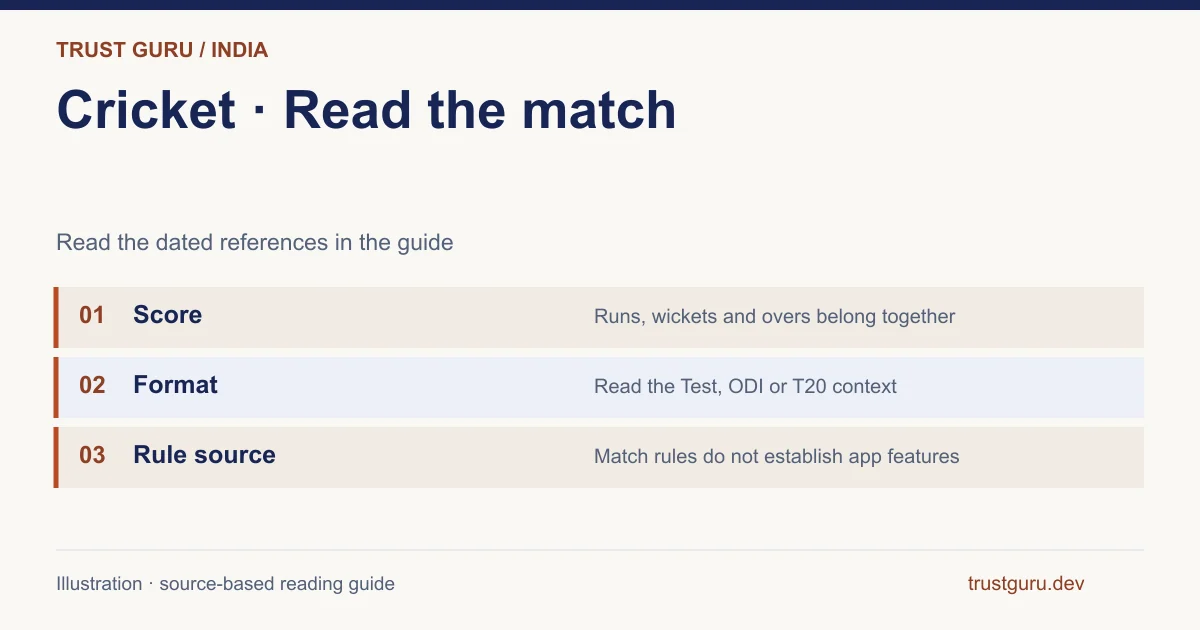
Read runs, wickets and overs together
Read a cricket total as runs and wickets lost, then examine the overs for innings progress. Deliveries that are not legal balls and recorded extras can make an informal ball count misleading. The score’s labels matter as much as the numbers.
In an overs label, .3 means three legal deliveries into that over. It is not three tenths of an innings or an ordinary decimal fraction. This is why counting legal balls and checking extras matters when comparing a score to an informal delivery count.
Identify the format and the stage
Confirm whether the fixture is a Test, ODI or T20 and which innings is in progress. Remaining overs, required rate and targets depend on that structure and any revised playing conditions. A saved score image cannot establish what is happening in the match now.
Use primary rules for a disputed point
The MCC Laws explain cricket’s fundamental rules. ICC playing conditions and the particular tournament’s documents provide further format and event detail. Consult the relevant edition when checking a dismissal, target or interruption rather than relying on an undated explanation.
Keep sports information separate from app claims
Displaying a score or social feature does not make an app the match authority. Identify its publisher and current product scope separately. This guide helps read cricket information; it supplies neither live scores nor a prediction or prize promise.
Read the decimal-looking over notation correctly
For example, 18.3 overs represents eighteen completed overs and three further legal deliveries. It is not 18.3 in decimal arithmetic. Interpret it with the innings and format; this number illustrates notation and is not a current match or team-selection recommendation.
Read a chase from runs, legal balls and the stated target
Assume an uninterrupted T20 example with a first-innings total of 160 and no revised target. The chasing side needs 161 to win. At 143/4 after 17.2 overs, 104 legal balls have been bowled: 17 × 6 + 2. A full 20-over allocation has 120 legal balls, so 16 remain. The side needs 18 more runs; the required rate is 18 × 6 ÷ 16 = 6.75 per over. The current rate is a different calculation, 143 × 6 ÷ 104, approximately 8.25. These are invented totals for interpretation, not a live fixture.
A wide can increase the total without consuming a legal delivery. If one wide alone changes 143 to 144 in this example, the legal-ball count remains 104 and the requirement becomes 17 from 16, a rate of 6.375. Do not add an ordinary decimal tenth to 17.2 or count every displayed event as a legal ball. Consult the scorecard’s extras and event labels. Dismissals and the innings-ending rules are separate conditions; 16 scheduled balls remaining does not guarantee the batting side will use them.
An interruption can invalidate the original chase assumption. If an official revised target is published, use that target, the revised allocation and the competition’s playing conditions. Do not invent a rain adjustment by prorating the original total yourself. A tie, no result and a later tie-break procedure also depend on the applicable format. Record what status the source actually displays rather than substituting an old screenshot.
For a rules question, identify the event before seeking the remedy: the delivery label, run/extras entries, wicket event, innings and competition edition. The MCC Laws explain fundamental rules; the relevant ICC or tournament conditions settle format-specific details. A fantasy provider’s point value for an event does not change the cricket law or the official match total.
- Identify teams, competition, format and innings.
- Convert overs to legal balls and read extras separately.
- Use the stated target and allocation; record any official revision.
- Consult the precise rule or playing condition for a disputed event.
| Observation in this illustration | Interpretation | Next action |
|---|---|---|
| Target 161; total 143 after 17.2 | 18 needed from 16 legal balls | Required rate 6.75, separate from current rate |
| One wide adds a run only | 144 runs; still 104 legal balls | 17 needed from 16 under the same assumptions |
| Revised target published after rain | The original example no longer settles the chase | Use official target and revised allocation |
| A points app assigns another number | It may be a separate scoring system | Check that format’s eligibility and points rule |
FOLLOW THE EVIDENCE
Sources and context
- MCC — The Laws of CricketReference check: 2026-10-30
- ICC — Playing conditionsReference check: 2026-10-30
The date records a reference check. It is not a live service monitor.
Trust Guru is an independent information website. We are not the brands’ official website, do not accept bets and never ask for third-party passwords or access codes. Editorial policy ↗