
INDIA / GAMES / APP REVIEW
Come Play Win App Review: Reading Bundle, APK and Login
Come Play Win App is presented as bundled reading material. This review identifies the source’s release and asks what the inspected Standard file supports about the pages inside it. Installation, offline access and any external account must be evaluated separately from a promising product name.

The four task buttons jump to guide sections on this page. The source record is a documentary reference.
Our assessment
A page bundle should be judged as reading material unless independent evidence establishes additional tools. A name containing play or win does not prove a game, a prize or an account relationship. The inspected file does not demonstrate each page working offline on a device.
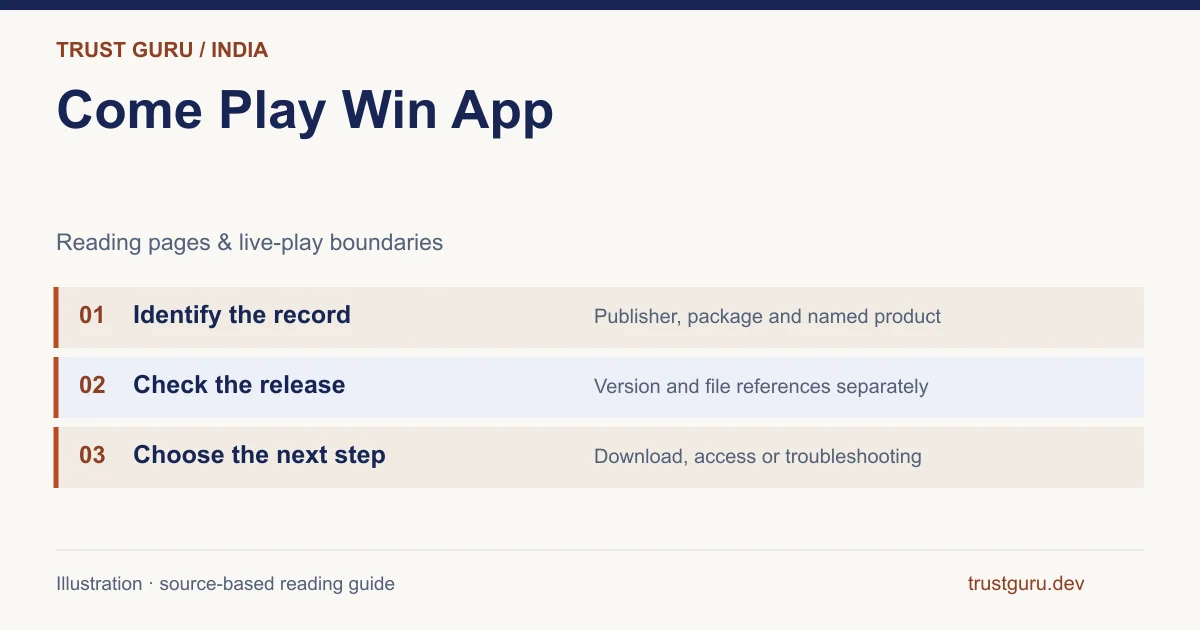
In this review
Source details and review scope
The record being reviewed
- Source label
- Come Play Win App
- Listed developer
- ComeAPK
- Listed version
- 1.0
- Listed size
- 19.74 MB
- Review scope
- Published documentation and task analysis
We compare published source records and file evidence. We have not installed the app, created an account or tested a login. Similar labels can refer to shared files or different services.
A website wrapper is the source’s stated product
The catalogue attributes Come Play Win App to ComeAPK and publishes version 1.0 at 19.74 MB. The guidance-wrapper proposal delivers reading material. The Play Win title does not establish an interactive game, reward, personal account or recoverable private history. The attribution remains a source statement rather than an independently authenticated company identity. The common Standard reference identifies com.come.sports version 1.0/code 1. Its contents include the website’s descriptive entries, which does not establish a separate implementation for every catalogue title. Another display name may refer to another page in that container rather than another Android application.
What the claimed 154-page bundle would mean
The acquired Standard inventory substantiates a document count of 154 HTML files: 45 directory pages, 35 blogs, 33 guides, 38 other English pages and three root/error files. The Play Win description is about delivering that published material, without a demonstrated game or reward feature. The 45 directory documents include 40 records, four category pages and an index. Counts cannot establish navigation quality, personal progress, recoverable notes or offline completeness; those would require actual reading and persistence observations.
No game, lobby or fantasy-sports task is established
The record explicitly says there is no contest entry, squad, lock-in deadline or operator account within the guidance pack. Define a successful outcome before deciding whether this record fits. Reading published guidance, organising retained files, checking participation and using a provider account are different jobs. A source description may help structure a manual review while leaving its claimed implementation unestablished. Evaluate the missing evidence against the actual need instead of treating the product name as a recommendation. This assessment does not rank installed alternatives, measure convenience or establish better sporting outcomes. The related material is offered to clarify task boundaries, with source claims, measured file facts and untested behaviour kept distinguishable.
The source’s proposed role is holding pages, not executing the activities described by those pages. For a first reading session, choose a concrete question such as how a lineup note is organised, what a package reference identifies or which rules a football guide assumes. The measured bundle contains articles and catalogue pages, so reading one can be a complete task in itself.
Download: the main route is not the file identity
The title describes a guidance wrapper rather than a measured game or payout feature. The Standard file identifies the website material that was actually acquired. The words Play and Win cannot establish a playable round, personal results history or entitlement. The inspected Standard object is com.come.sports version 1.0/code 1, 20,696,772 bytes, SHA-256 6bf5b47239c4407dfb97d7c49b5639ab1f7b335fb5fff05e0360aa1f11338ccd. Current and archived filenames returned identical bytes. The separate Game object is not an older or newer release of that package. Preserve the release reference and observation date so later findings are compared with the same object and stage. Record which manifest row names that object before comparing another download.
Installation: a wrapper still needs a verified release
Installing a reading container and retaining personal notes are separate outcomes. Neither was tested. The release’s Android structure supplies no reset, reinstall or shared-device preservation guarantee, and a successful launch would not demonstrate a winning mechanism. For the acquired Standard file, minimum SDK 24 means Android 7.0; target SDK is 36 and debuggable=true. Project-local static APK v2 signed-data and content-digest checks used its Android Debug certificate. This establishes a file-level signing result, without publisher authentication, installation, safety certification or runtime testing. Preserve the release reference and observation date so later findings are compared with the same object and stage.
The no-sign-in claim applies to this guidance pack
The guidance claim does not identify an operator account or a verified recovery service. The saved material establishes no separate Play Win username, OTP route or shared profile. A personal history missing after reinstall would need its actual storage owner and event sequence. The investigation did not submit credentials, request an OTP or inspect a signed-in session. For an existing account, retain the actual provider and stage reached before changing software. A failed page load, rejected password and missing local record require different evidence. Trust Guru cannot authenticate a user or restore a provider-managed profile. Preserve the release reference and observation date so later findings are compared with the same object and stage.
Registration is not the stated first-use task
No demonstrated signup supplies an entry, reward or profile for the guidance bundle. A first-time reader should identify whether a later form concerns reading preferences or another provider. The title cannot supply registration conditions, eligibility or an authenticated prize claim. The assessment performed no registration or agreement. Obtaining a file, allowing an Android permission, reading a public page and joining an external service have different consequences. Any required data and location restrictions must come from the identified provider’s current process. Neither a catalogue caption nor a checksum can establish that an account is approved. Preserve the release reference and observation date so later findings are compared with the same object and stage.
Bundled pages and fetched-page cache are different
The 154 HTML files in the acquired APK provide a concrete packaged inventory. Separate initial availability from later use. Content shipped inside a package, a page cached after visiting it and information retrieved afresh require different connections. Reading a saved explanation cannot establish current team news, new releases, an external account or a newly downloaded file. A useful offline record also retains when its information was obtained. Restart, eviction, reconnection and changed-file behaviour need their own observations; none follows merely from a small installer or a local-reference claim. For travel, retain the intended document and its source date independently of any untested promise about complete offline operation.
Reinstalling does not automatically preserve a cache
The same distinction applies to a factory reset or a move to another profile. The description suggests that guidance stays readable after reinstalling or when the website is unreachable. The first claim needs careful qualification. Reinstalling can remove an application’s local cache, while newly bundled public pages may become available again from a fresh package. Those are different forms of continuity. We have not tested retention, restoration or a clean installation, so we cannot promise that previously fetched state survives removal and replacement.
A public page can be recoverable without preserving reading history or local annotations. The source does not by itself establish a backup format or cross-device sync. Before relying on the pack as an archive, a reader needs to know what is included in the file and what exists only in local storage. Our review treats the source’s permanence language as a claim requiring a device test.
Keeping a packaged website current
For someone seeking an old version, the reason matters. The published entry lists version 1.0 with an October 2026 release reference. We did not verify a change log, automatic updater or package replacement. A wrapper can change independently from the website it displays, and cached pages can lag behind both. A useful maintenance record should say whether an update refreshes bundled content, remote scripts or only the container. A single latest label cannot answer all of those questions.
An earlier bundle may preserve a historical page but also retain outdated guidance or broken links. A digest can identify a particular reference without proving continuing usefulness. Reinstalling the same version also cannot guarantee the same remote content if it opens live pages. No rollback, migration or offline archive behaviour was tested, so those tasks remain separate from release identification.
Permission and network claims need inspection
The source’s highlighted sensitive categories—contacts, SMS, accessibility and device administration—are sensible prompts for scrutiny, but their stated absence does not answer every data question. The Standard manifest declares INTERNET and an app-scoped receiver permission; contacts, SMS, accessibility and device administration are not among those declarations. This describes the shared Standard Sports APK we inspected, not a separately authenticated implementation of a reader for the source website rather than a playable game. A manifest declaration is different from a permission actually granted, data sent over the network or a device prompt. No traffic capture, runtime permission test, account-data inspection or complete privacy assessment was performed. The 154 HTML files support the website-bundle description; they do not by themselves establish a game lobby, winnings or a clean offline start.
Storage, diagnostics, external links and profile sessions also matter. A matching file digest cannot establish which organisations receive network requests. The review therefore avoids a general safety certification and instead records the specific tests needed to assess the simple reading model the source describes.
When the pack does not do what the name suggests
If there is no game lobby, squad builder or winnings screen, the source’s stated scope may explain the result. Preserve the source URL, displayed version, page title and connection state when documenting a problem.
You wanted to play, but the object contains reading pages
A playable game needs rules, a game state and an identifiable service; a title containing play or win does not establish them. Suppose the acquired object opens an instruction page and offers reading links, but no lobby, team submission or winnings record. The bounded result is a readable guide. The source’s stated scope can explain that outcome without treating it as an installation failure or promising that another login unlocks a game.
If reading is useful, test that exact task in the present state: identify the article path, its date and whether it is bundled or fetched. An offline missing page should be reported separately from absent gameplay. A reinstall may change local cache and preferences, while a public page reopening would still not demonstrate recovery of private notes. If the user actually wants to participate in another service, identify its provider, current rules and confirmation process before moving away from the guide. This makes the next action relevant to the original intention instead of escalating from a naming misunderstanding into an unnecessary account or payment.
- Describe the intended action in one sentence.
- Compare that action with the source’s actual scope.
- Keep a failed article load and an unrelated operator account as separate reports.
| Observation in the example | What it establishes | Next decision |
|---|---|---|
| Instructions open without a lobby | Reading works; gameplay remains unestablished | Choose reading or identify a separate playable product |
| One article is unavailable offline | That resource is missing in this state | Keep its path and prior-fetch history |
| A new external login appears | Another service owns that account task | Verify its identity; the guide supplies no shared credentials |
Questions about Come Play Win App
Can I play a game inside Come Play Win App?
The source describes a guidance reader and excludes a lobby, leaderboard, squad and contest-entry path. No package execution was performed. Its title supplies no evidence of a playable client, wallet, earnings function or automatic contest action.
Does it require login or registration?
Within the guidance pack, the source states there is no sign-in. Runtime access was not tested, and that statement does not extend to external destinations. A new form needs its own identified owner; it cannot be assumed to belong to the reader or share a sports-operator account.
Are all 154 pages available offline immediately?
154 HTML files is a measured inventory, without an offline-render result. The saved worker precaches four paths, uses cache-first for static assets and network-first with fallback for other same-origin GET requests. That does not guarantee every route is cached on first use. The live worker differs, and no clean disconnected launch was tested.
Will cached pages survive reinstalling?
Reinstallation may remove local caches while making bundled public pages available again. Those are different from restored annotations or reading history. No migration or backup process was tested, so the review cannot promise that retained personal state survives a reinstall.
Is this suitable for fantasy-cricket account access?
The source explicitly excludes fantasy-sports functions, squads, lock-in and an operator account. A different service or planning record is needed for that task. Shared catalogue metadata and a similar title establish no account compatibility, so this reader cannot be treated as a verified account-access client.
Where do I create a squad or view a leaderboard?
The guidance pack is described as a website reader without lobby, squad or leaderboard controls. Any external service offering those features has its own identity and rules. Their appearance after a link would not establish that the reader has the same account or implements those controls.
Can two people read it without sharing a sports account?
The stated reading scope has no own-pack sign-in, but that cannot establish remote-account behaviour on a shared phone. Identify any receiving origin and its session separately. No multi-user isolation or successful external sign-out was tested, so account separation cannot be promised from the reading description alone.
FOLLOW THE EVIDENCE
Sources used in this review
- Come Play Win App — ComeAPK source record
- ComeAPK — source app directory
- Source platform manifest: shared Standard Sports release
Review date: 31 October 2026. The source pages provide claims and guidance; listing them does not establish that a download or account flow works.
Trust Guru is an independent information website. Read our review method or send a sourced correction.