
INDIA / GAMES / APP REVIEW
Come Gaming APK Download Review: File Filter, Install and Login
Come Gaming App Download describes a file-manager and filtering concept while referencing a Game-family release. That combination needs careful attribution: the source narrative, the acquired file and an external service may describe different objects. This review follows each layer through download, installation and account questions.

The four task buttons jump to guide sections on this page. The source record is a documentary reference.
Our assessment
The source’s proposed filter needs observed behaviour before it can be treated as an enforced protection. A package inspection or matching digest alone cannot demonstrate rejection of unsuitable files, a reliable download queue or a successful service login.
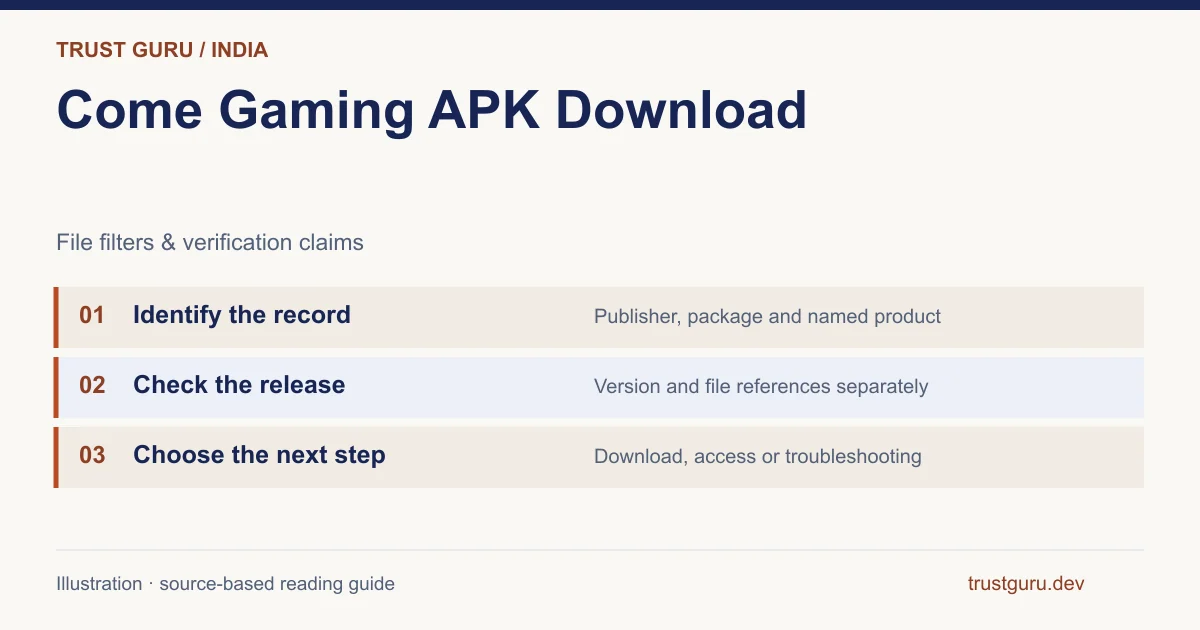
In this review
Source details and review scope
The record being reviewed
- Source label
- Come Gaming APK Download
- Listed developer
- Come App Team
- Listed version
- 1.0.2
- Listed size
- 5.00 MB
- Review scope
- Published documentation and task analysis
We compare published source records and file evidence. We have not installed the app, created an account or tested a login. Similar labels can refer to shared files or different services.
A filtered downloader with an unresolved shell description
The catalogue attributes Come Gaming APK Download to Come App Team and publishes version 1.0.2 at 5.00 MB. The pre-offer filter proposal hides a rejected file rather than displaying an installable warning state. Exclusion needs a reason that remains distinguishable from absence. The attribution remains a source statement rather than an independently authenticated company identity. The Game reference identifies com.khtybugazu109.com version 1.0.2/code 2 with a LUCKX host configuration. Shared file measurements cannot demonstrate every portal, scanner and catalogue function described under nearby names. The Standard website bundle has a different package and signer.
What pre-offer filtering would change
The page says an unsuccessful comparison is not shown greyed out or marked with a warning; the file is not offered as an installable item at all. Begin with an independently attributed expectation, then measure the actual object. Filename, package label, byte size, version and full digest have different roles; agreement with one does not supply the others. A copied hash is reference presentation, without demonstrating that a local file was selected or measured. Preserve unknown, unreadable and different as separate outcomes. The origin and date of the expected value matter even when the comparison is local. A matching digest identifies correspondence with that reference; it does not certify publisher authorisation, safety, compatibility, account access or the feature advertised by a page.
We have not supplied an altered file, watched a comparison or inspected an error log. The source states the intended result, but does not by itself establish its enforcement here. Compare this with the portal record, which describes a pending state and a surfaced failure; the two interfaces answer a similar problem differently. A useful result should say “not transferred,” “not read,” “no matching release reference” or “digest differs,” with a reference date where applicable. The inspected LUCKX configuration does not by itself establish any of these proposed local states.
The catalogue table is part of the trust decision
According to the source, the device stores expected Android package identity, version and size, and the file-digest comparison runs against that table. Keep the expected release separate from the object being checked. A local table can remain available without a connection, but its origin still depends on the bundle that delivered it and any update process. Reading a file’s own label and treating it as the expectation would be circular. The record needs an attributable reference date, complete identity and an explicit state for unknown or changed releases. No signed refresh, expiry rule or conflict-resolution behaviour was demonstrated. Preserve the earlier comparison as history if the reference later changes, rather than silently rewriting what an old result meant.
Local storage alone does not make a reference independent or correct. We inspected the shared Game package and its signature; the advertised filtering implementation was not established. Keep the source row, its date and the chosen package fixed while recording the actual bytes separately. The website’s reference-copy action is useful for retaining the expected string but is not a checksum calculation. A positive result would still establish agreement with that reference, not legal publisher identity, harmless behaviour or a successful device installation.
Downloading the tool is not the same as downloading a listed game
The defining proposal hides failed files before they are offered. Its acquired Game object instead identifies a LUCKX-configured shell. A common release reference is useful, while remaining insufficient to demonstrate pre-offer filtering, a queue or a sports-file downloader. The acquired Game object is com.khtybugazu109.com version 1.0.2/code 2, 5,238,435 bytes, SHA-256 49b56d4eb19bac86360063b77f270629129c4abdd9e866226093de286b324b2d. Its static configuration names LUCKX. Standard uses another package and signer and cannot serve as a Game update reference. Preserve the release reference and observation date so later findings are compared with the same object and stage. Record which manifest row names that object before comparing another download.
Android installation remains contradicted and untested
Android metadata describes the shared Game release, without demonstrating the proposed hidden-item design. No installation, package replacement or child-file acceptance was performed. If an item is absent, the source would still need to show whether it failed comparison or never entered the process. The measured Game manifest declares minimum SDK 24/Android 7.0, target SDK 34 and version code 2. Static APK v2 signed-data and content-digest checks used its certificate labelled CN=APK Builder, O=Yudb, which differs from Standard. That does not authenticate a legal publisher, certify safety or establish device compatibility. Preserve the release reference and observation date so later findings are compared with the same object and stage. The source’s Practical Security Checks panel says the file declares no permissions and cannot be installed. That conflicts with the acquired shared file’s readable Android manifest and declared permissions; it does not resolve whether the separately described feature exists.
A hidden or rejected catalogue entry cannot be explained from signer metadata alone. The Game file’s retained certificate has fingerprint E0:B3:41:12:35:3B:4E:BC:CF:96:47:DB:8D:38:4A:F4:C6:8E:CF:74:4B:F1:9D:A9:B5:DE:4D:66:E4:38:C9:AA and the self-signed subject CN=APK Builder, O=Yudb. These are identification fields, without independent confirmation of a legal publisher, safe behaviour or the proposed comparison feature. Standard’s CN=Android Debug signer is different. Any later check should record the package identifier, file digest and date beside the relevant certificate, then examine the missing-item stage separately; sharing a label or an entry screen does not make the two signing references interchangeable.
The filter and the external channel may have different accounts
The source’s lack of a wallet or entry mechanism does not settle the downloader’s account model. No login, OTP or recovery was demonstrated. Fixture notes, a file queue and a host profile have different owners even when navigation places them in one journey. No sign-in, code request or recovery operation was carried out for this assessment. Trust Guru publishes the documentary comparison and does not issue credentials. Keep the provider, receiving origin and last successful screen with a private error record; a package identifier, copyable hash or familiar display name does not establish which service owns an account. Preserve the release reference and observation date so later findings are compared with the same object and stage.
Signup requirements cannot be inferred from a file catalogue
The material contains no verified signup endpoint, required fields or agreement for the filtering tool. Its own description leaves financial and identity conditions to external operators. A form reached through the shell requires separate attribution rather than a fabricated universal setup sequence. No new-user, consent or eligibility outcome was tested. The necessary next evidence is an attributable current form and terms for the intended service, rather than a guess based on a common market pattern. A file download does not accept those terms for the reader, and Trust Guru does not collect registration details or act as the account provider. Preserve the release reference and observation date so later findings are compared with the same object and stage.
Offline catalogue visibility and verification freshness
The source claims the bundled catalogue remains readable outside coverage and that previously verified files remain recognisable. Separate initial availability from later use. Content shipped inside a package, a page cached after visiting it and information retrieved afresh require different connections. Reading a saved explanation cannot establish current team news, new releases, an external account or a newly downloaded file. A useful offline record also retains when its information was obtained. Restart, eviction, reconnection and changed-file behaviour need their own observations; none follows merely from a small installer or a local-reference claim. For travel, retain the intended document and its source date independently of any untested promise about complete offline operation.
It does not mean a new file can be downloaded without connectivity, an external channel can load offline or a reference table can stay current indefinitely. Moving, replacing or truncating a stored file should not preserve an old ready state without reconsideration.
Separate gaming storage: organisation versus duplication
The stated 5.00 MB size refers to the release claim, not the total space used by installed code, cached pages, references or retained packages. Measure storage categories separately: transferred installer, installed code, cached pages, retained child files, exported notes and index records. A release’s download size cannot establish installed footprint or a precise minimum handset capacity. A local list can also outlive a moved file or omit something still present on disk. No cache-growth, duplicate-storage or cleanup result was measured. Before treating a collection as complete, establish which locations and object types it actually covers. Source size and capacity statements remain attributable claims, without becoming tested hardware requirements or a recommendation to remove files indiscriminately.
The source does not by itself establish a measured storage budget or an interface for identifying duplicate files. This review offers no tested cleanup sequence and does not assume removing a catalogue entry removes the underlying file.
A downloader is not automatically an app updater
The source explicitly says the sample does not update applications already installed on the handset. A notice about another release is information, without acquisition or installation. Establish where the current version comes from, who publishes the proposed replacement and when the reference was checked. An offline record can preserve the last comparison without proving that no newer release exists. The source’s own update, its catalogue and a child app may have different timelines. No background monitor, migration or automatic replacement was tested. A useful update history would preserve why an entry changed and which old state remains relevant, rather than turn a prominent Latest caption into proof of current software or sports information.
Obtaining a newer package, checking it against a reference and replacing an installed app are separate operations; this record does not by itself establish all three as a completed workflow. Its own version is listed as 1.0.2, but an evaluated changelog, supported migration path and old-release archive are not established here. An old version may still match its historical checksum while lacking current information.
Attribution reporting requires its own explanation
The Game manifest declares internet and network-state access, notifications, advertising and attribution permissions, and write-storage permission limited to SDK 28 or below. Read permissions as declarations in a particular file, then ask which task and recipient would use them. A manifest does not record a phone’s granted permissions, runtime prompts or transmitted data. Standard and Game have different declaration sets and must not inherit each other’s privacy conclusion. Local readability also cannot establish an absence of network communication. A file list, selected folders, personal analysis and an external account can expose different information. This review did not capture traffic, inspect private account data or complete a runtime privacy assessment, so it provides scoped observations rather than a safety or privacy score. This describes the shared Game APK we inspected, not a separately authenticated implementation of a catalogue that hides files until a verification gate passes. The LUCKX shell configuration does not demonstrate pre-offer filtering, a local verification queue or a catalogue that excludes failed files. The page also says the intended sample does not need SMS, contacts, accessibility or device-administration privileges. A file with limited device access may still contact a remote service, and a file-digest comparison says nothing about that service’s retention practices. Readers should not have to infer privacy from the word filter or from a rounded file size.
A missing item is not enough to diagnose the failure
If a user sees no item, however, the cause could also be an unfinished sync, an unavailable category, an absent file or an older reference set.
The source does not by itself establish that explanatory interface. Given the mixed shell description, that should first trigger a product-identity check, not a password reset or repeated reinstallation.
Who should consider this design?
The source itself says store-only users and people satisfied with an existing package manager may gain little from another tool. Define a successful outcome before deciding whether this record fits. Reading published guidance, organising retained files, checking participation and using a provider account are different jobs. A source description may help structure a manual review while leaving its claimed implementation unestablished. Evaluate the missing evidence against the actual need instead of treating the product name as a recommendation. This assessment does not rank installed alternatives, measure convenience or establish better sporting outcomes. The related material is offered to clarify task boundaries, with source claims, measured file facts and untested behaviour kept distinguishable.
Our conclusion is that the record raises worthwhile design questions but does not yet answer the implementation and identity questions needed for a product recommendation.
Nothing is offered: missing coverage, unreadable file or failed comparison?
An absent item cannot by itself prove that a verification gate rejected a file. Imagine a reader expects a saved APK to appear, but the interface is empty. The described pre-offer filter might be relevant, yet an unfinished transfer, inaccessible folder or reference that does not cover that release would create different questions. Establish whether there is a local object and whether the intended surface can actually read it before interpreting the absence as a security verdict.
If bytes are readable, keep expected source/date and measured fields side by side. A published value copied to the clipboard is not the actual measurement. An unknown version needs its own reference; a complete different digest remains disagreement. No altered-file handoff or native filtering implementation was demonstrated in the inspected Game shell. The reader can still make a useful evidence-based decision: do not force a positive status by replacing the expectation, changing a filename or using another product’s account. Identify the failed layer and use the corresponding record. Agreement with an independent reference remains narrower than a safety or availability claim.
- Find the exact local object rather than another similarly named card.
- Keep unknown, unreadable and different as distinct states.
- Only ask an installer question after identifying the file.
| Observation in the example | What it establishes | Next decision |
|---|---|---|
| No saved object can be identified | The acquisition stage is unresolved | Retain the intended delivery URL |
| File exists but is not readable | Access is unresolved | Keep the access/path result before comparison |
| File is readable but release is unknown | No applicable expected value exists | Leave the result unknown |
| Complete digest differs from the same release | A comparison discrepancy exists | Keep both values and their provenance |
Questions about Come Gaming APK Download
Why might a downloaded file not appear in the catalogue?
The source claims exclusion after mismatch, but an absent row could also involve synchronisation, filters or storage. No working interface or rejection explanation was tested. Record the transfer and read stages before attributing an omitted file to the proposed comparison gate.
Is this different from Come Game APK Download?
The descriptions propose different states: this record excludes files before offering them, while Come Game APK Download retains pending or failed entries. Their shared declared release metadata does not demonstrate independent software. Compare those claimed workflows without treating different titles as proof of separate binaries.
Can it update games already installed?
The source expressly excludes updates to already installed apps. A checked incoming download would still be different from accepted replacement and preserved game data. Neither automatic maintenance nor migration was tested, so a downloaded file must not be presented as a completed update.
Does it work without internet?
An offline catalogue may be a retained snapshot. New transfers, current references and an external game channel can still require a network. Persistence and changed-file detection were not tested; seeing a local row cannot establish that its download or hosted game is currently available.
Why does the review leave login and installation unresolved?
The saved source leaves the account model unclear and combines install instructions with a non-installable claim. It also mixes a hosted-channel shell into a downloader description. These unresolved object and feature conflicts prevent a supported device or login walkthrough; no successful results were invented to bridge them.
If no game appears, has the filter proved it was unsafe?
An empty selection is no security verdict. The incoming file may be absent, unreadable, without an applicable reference, or actually mismatched after comparison. The source has not demonstrated which of those states its interface exposes, so lack of a game cannot establish that unsafe software was filtered.
What information makes a pre-offer comparison useful?
Identify the intended package and release, date the expected reference, then show that the incoming bytes were read and independently measured. Copying a reference or changing it to match defeats that purpose. These are assessment criteria; no working pre-offer implementation was demonstrated in the shared Game object.
FOLLOW THE EVIDENCE
Sources used in this review
- ComeAPK: the source record reviewed
- ComeAPK: directory and neighbouring records
- Source platform manifest: shared Standard Sports release
Review date: 31 October 2026. The source pages provide claims and guidance; listing them does not establish that a download or account flow works.
Trust Guru is an independent information website. Read our review method or send a sourced correction.